
% Bureaucracy

I’ve recently had the misfortune of leading a contracted integration project with a very bureaucratic government agency, as a private sector vendor (software product startup). While my company was agile, our client was decidedly not. Emails I intend for one or two recipients end up with 20 ccs. Requests that take one minute to answer get passed to entire teams then down the chain of command to someone entirely clueless about the business context and needs to catch up all over again. Timelines keep getting planned, re-planned, secretly pushed. Complete requirements-gathering manage to both block the commencement of work, and remain arbitrarily variable after signoff. Random stakeholders would spring from the void and declare priority of their own scope. Meetings upon meetings get thrown on my calendar, half of which are their internal experts discussing with jargon that means nothing to us.
I was wholly unprepared. As a product manager, a mostly internal role, I’ve been graced with plenty of client-facing experiences in which I’ve retained my style as a real human being, with goodwill and boundaries, and find like-minded allies on the other side to do mutually beneficial business with. This usually works. My company was unprepared too. For the most part, we’ve operated fluid and lean. Due to this interaction, executives at my company decided we should develop more bureaucracy to handle their bureaucracy. More chain of command, process of escalation, points of contacts. Every fixture our client had, my company wanted to have, too. Except we were 1% the size of them.
I felt suffocated as walls rose around me. This is one of those depressing conversations you’d have as a child with boring adults, where you’re told that grown-ups have responsibilities, and that’s why they’re boring like them. And you think to yourself, sounds like I’m doomed to become monotonically less cool. I don’t want to grow up then.
Except it wasn’t true. I grew up, and discovered that adults can be cool -- just not the ones that warned me about adulthood like that back then -- there exist cool adults who are doing well with their responsibilities but are not boring and soulless. I could be one of them.
Now I’m wondering the same about bureaucracy. Is it an inevitability? Is it a gift, a curse? Is it an equilibrium?
In close proximity to this client, my first realization is that there are real people inside the bureaucracy. Through every deferral, deflection, process, and strong-arming, an individual’s actions are generally either well-aligned with their job KPIs, or the business goals. The more central someone’s role is to core business interests, the more likely they’re rationally incentivized to align with business goals: quality of work, operational cost, morale, risk control. On the other hand, the farther away, the more likely they’re misaligned. Their KPI becomes task completion rate & time, whether they make good with their direct supervisor, whether they leave behind overt ammunition that can be used to sabotage their career, even if as a sacrifice for business prosperity. They want to keep their jobs, climb the career ladder. They don’t know what the executives are fighting over in the business because they’re so far removed; so they look at the path beneath their feet and take each step measuredly.
Bureaucracy begets bureaucracy. Once the % of blind task-doers (people with misaligned or irrelevant incentives) reaches critical mass, the organization will often start to emit misaligned signals. This is an emergent phenomenon. Each individual may be well-aligned to their own KPIs, and those KPIs may be well-designed for their role, but because they can’t all learn the relative importance of their work to the goal, they will each err on the side of caution and reserve extra priority for their own specialty. Then you need to hire people whose sole job is to align these vectors so that they might move forward together at all. Then those project managers create an extra layer of delays and information loss due to translation. Then there are so many meetings, and you need people to organize meetings. Ad infinitum.
The word bureaucrat comes from the French bureau (desk, office) + Greek -kratia (rule): “rule by desk”. I’m defining a bureaucrat as someone whose work product is governance itself — policy, regulation, administration, adjudication, record-keeping, taxation — rather than a tangible frontline service.
Generally, frontline services, such as public school teachers, public hospital doctors, are scaled up or down based on public needs. It’s rare that they’re too bloated, and even so, I would hesitate to call it bureaucratic. However, “ruling by desk” jobs typically scale up or down based on governance conviction, that is, it’s cultural or discretionary.
Doubtless, some desk-side-ruling is essential to organize a pluralistic society; to make decisions for a group, concentrate resources to get things done, enforce the common moral code. I can’t imagine modern life without it. But when an outsider like me can clearly observe dysfunction from scale, one does wonder: how many people do we really need to govern over 1 million people? 1 billion? Do we want a big government covering many facets of life or a small government only supporting the basics? Can we function with less? Would we be more successful with less?
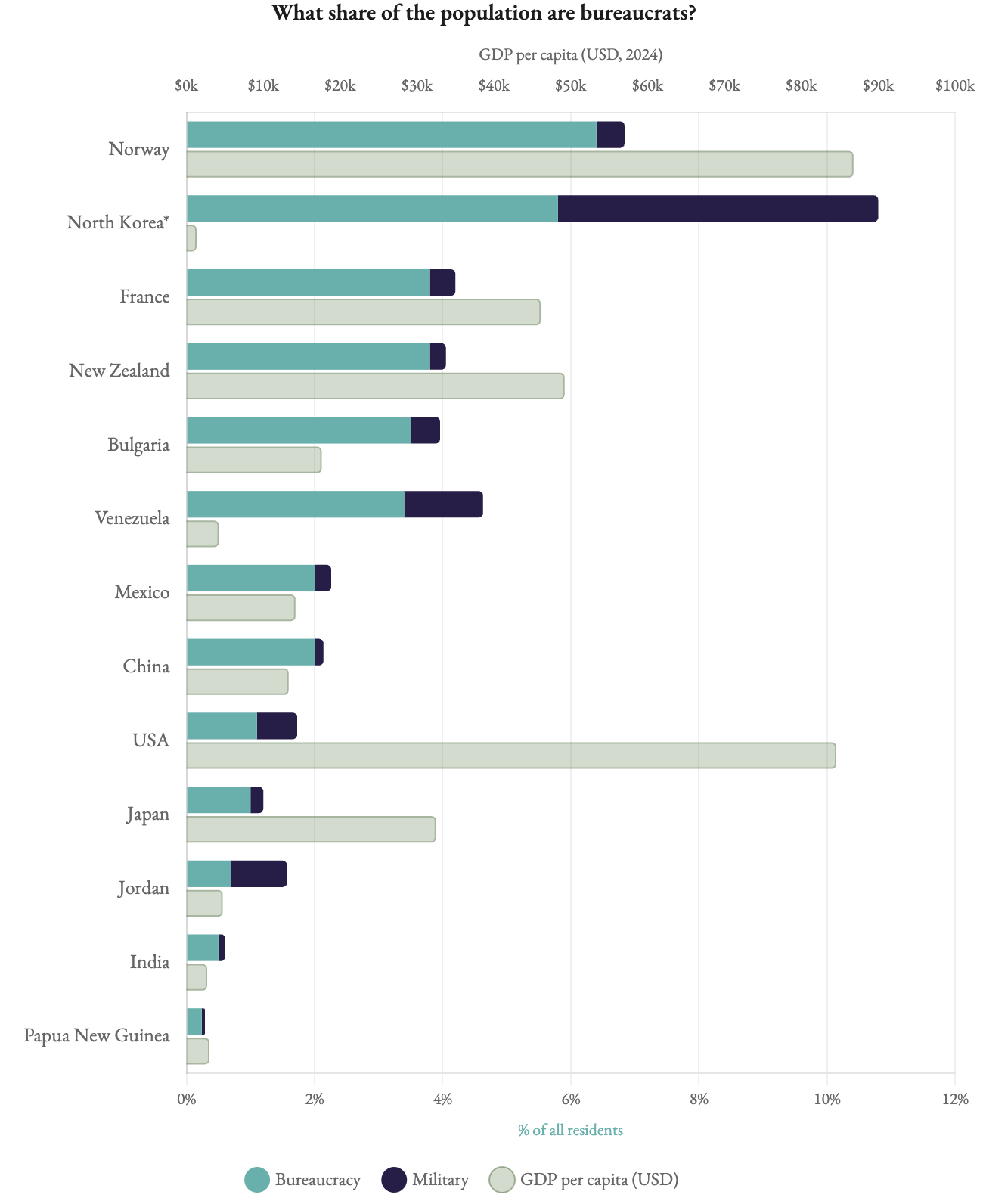
Let’s start with some sample countries, looking at their bureaucracy size against population and economic output. Military is the grey area here -- it generally doesn’t count in my definition but I’m showing it in fig 1 for perspective -- as military generally exists due to government conviction, much like the rest of the bureaucracy, and isn’t fully correlated with public needs.
Plotting total resident population against bureaucrat population (non-military)1. Both the log scale and linear scale show clear outliers/significant discrepancies. The main observation here is countries over the regression line of this group (more bureaucratic) are not necessarily operating more efficiently than countries under it, nor vice versa.
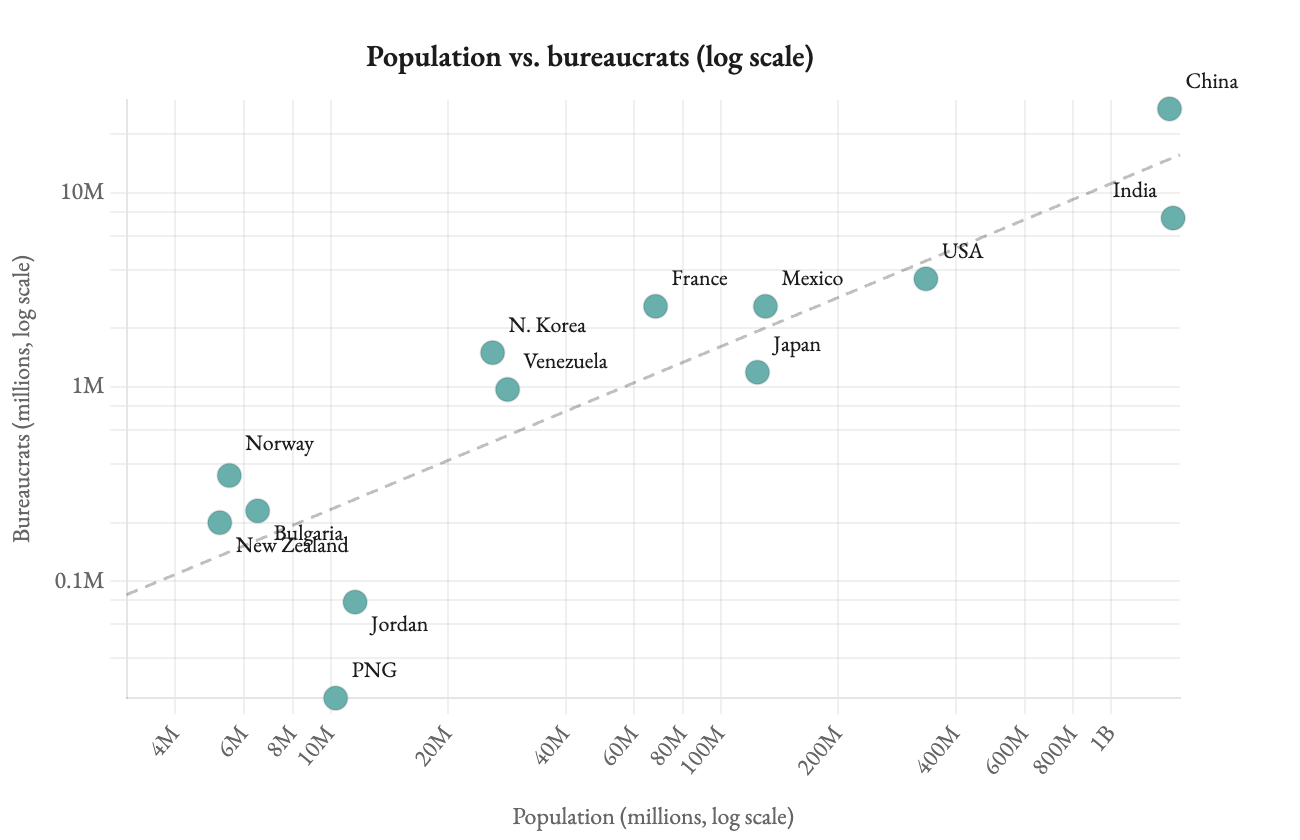
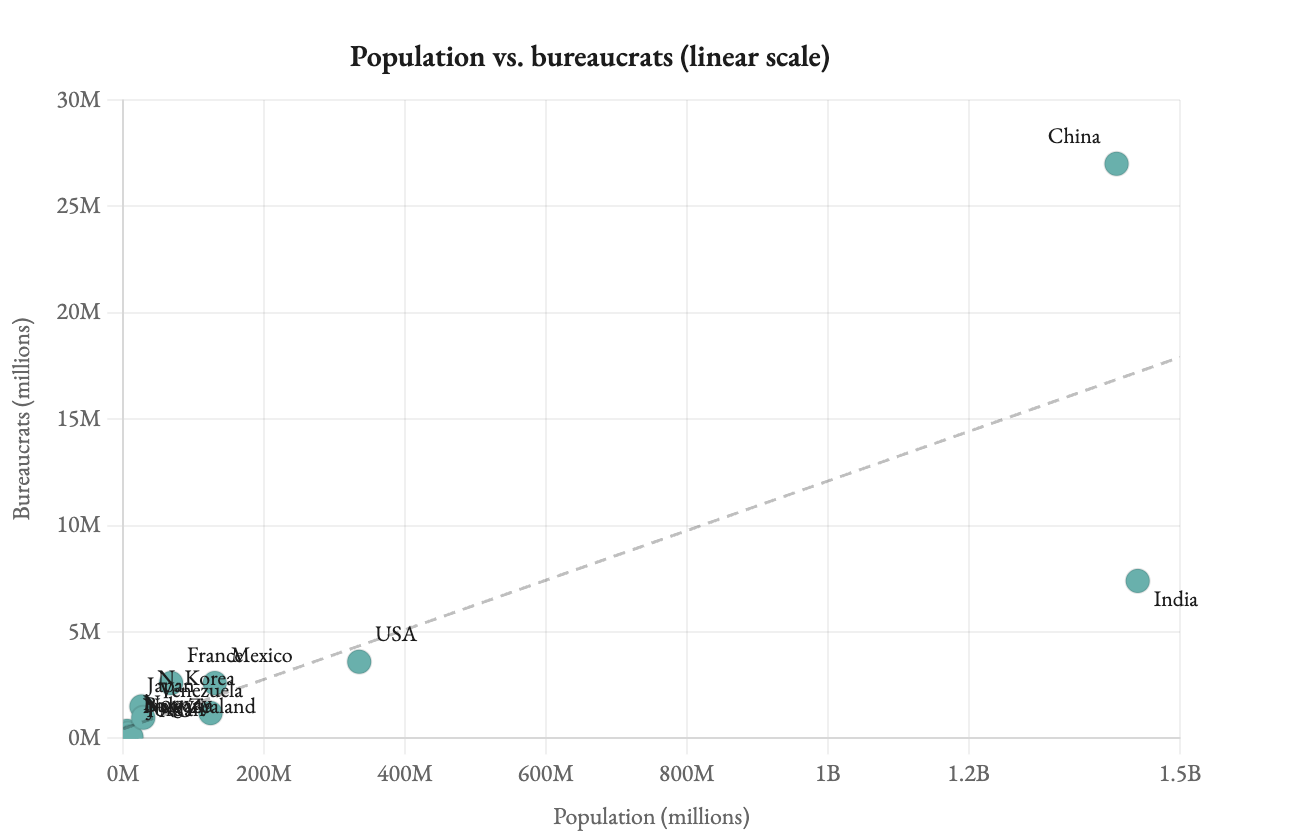
Further, linear regression seems the correct model; e.g., bureaucracy does not seem to be increasing exponentially as countries get more populous.
% Bureaucracy = f(governance conviction)
The portion of bureaucrats to total residential population seems to mostly be a function of governance conviction, whether the people in power or the public (in the case of a functional democracy) considers bureaucracy “good for business”. High % bureaucracy is not a necessary or sufficient condition to have a prosperous society. But for a government, “good for business” doesn’t just mean governing efficiently and effectively. Government cares about its own stability, and as such might care about:
jobs bureaucracy thereby produces
public opinion if specific departments are cut and media twists the intention
flexibility in routing power through different positions and factions
What Happens If We Cut Bullshit Jobs?
DOGE tried to; about the thousandth attempt in history. The Department of Government Efficiency, led by Musk under Trump, is not considered a particular success. Small-government conservatives have always been at this from a more general angle, too: rather have 20% of the people performing 50% of the function, than 100% of the people performing 100% of the function.
What’s behind the resistance to downsizing, if the size of the bureaucracy is not a strong determiner to success? Consider bureaucrats as their own species. Nine times out of ten, the government’s biggest incentive is to keep itself running. Like evolution -- any species that you see today, that has lasted through centuries, are all about their own survival and reproduction -- the government exists to justify and expand itself. Unless we were airdropped into an utopian equilibrium, any government that didn’t justify and expand itself would soon be marred with inadequacy and forced to abandon the conviction. Of course, at some point the fiscal pressure threatens the government’s very being as taxes are no longer sufficient to keep the machine running; whether that’s true or a preemptive concern by whoever is in power, the meta self-correction mechanisms like DOGE happens once in a while.
In my interaction with people with bullshit jobs, jobs which -- if they didn’t exist, the net productivity and public utility alignment would go up -- I often considered what would happen if Elon Musk or some other out-of-touch individual were to threaten to cut their job. First, there would be a lot of documentation. Tons of documentation, more documentation than work actually accomplished, to describe each time they were involved, and it would seem like 40 hours a week of useful work was accomplished. Second, gone with the bureaucrats are the processes that engaged them. Layers of approval, alignment, and escalation; everyone else in those processes would feel more directly exposed to responsibility, and that is not universally welcome news. Third, they might cite performance reviews that reflect they’ve pushed the paper exactly the right way for eight years. How can you punish someone whose job title is Planner of Good Things who has done an exemplary job for eight years? Do you hate Good Things?
At the end of the day, individuals are blameless. No one wants to cut their own job to make their organization more efficient, because knowingly or not, part of the job of being a bureaucrat is to justify being one.
Data Cleanup Method (LLM-generated)
Every international dataset on “public sector size” measures something different, and the gaps between definitions are large enough to flip a country’s ranking.
Three nested circles of “public sector.” The narrowest circle — bureaucracy — is what we measure here: the people who run the machinery of government. The middle circle — general government (OECD’s definition) — adds frontline workers: soldiers, teachers, doctors, police. This is what most international comparisons report. The widest circle — public sector (ILO’s definition) — further adds commercial state-owned enterprises like Equinor (Norway) or PDVSA (Venezuela). The difference between the narrowest and widest circles can be 5–10x. Norway is 30% “public sector” but roughly 6% bureaucracy.
How we subtracted. For each country, we took total government employment and removed: active-duty military, frontline police officers, public school teachers, public hospital clinical staff, firefighters, and social workers doing casework. What remains — ministry staff, tax officials, regulators, judges, municipal administrators, back-office operations — is what we call “bureaucracy.” Desk officers within the military or police are included. Hospital administrators are included. State media journalists are included. University professors are not (academic, not administrative).
OECD countries (Norway, France, USA, Mexico, Japan): we started from “general government employment” under the OECD’s System of National Accounts (SNA, 2021 data), which excludes commercial SOEs by definition. We then subtracted frontline workers using COFOG functional breakdowns or national statistical office data (US Census ASPEP, INSEE, SSB, INEGI).
China requires special treatment. The ILO says 25.5% of Chinese employment is “public sector” — but this includes ~100M+ commercial SOE workers. Chinese domestic sources report 财政供养 (”fiscal-supported personnel”) of 57–80M, but this still includes ~18M teachers, ~7M clinical health workers, ~2M PLA soldiers, and ~1.5M frontline police. After subtraction, we estimate ~27M bureaucrats. The range across scholarly sources is wide: the Xiamen University study estimates a lower total fiscal base than the popular 80M figure, and the gap hinges on whether 编外人员 (off-establishment contract workers) and 离退休 (retirees on fiscal pensions) are counted.
Other national sources. India: ~23M total government employees (PRS India), subtracted to ~7.4M admin. Jordan: 218k civil service employees (زاد الأردن / Civil Service Bureau, excl. military and security), minus ~120k teachers and ~25k clinical health workers, plus ~5k military admin = ~78k bureaucrats. New Zealand: 462k total public sector (PSC 2024), broken down by function (149k education, 91k health, 31k public safety, 13k defense) — ~200k bureaucrats remain. Bulgaria: 558k budget-funded employees (BTA 2024), of which 28% education, 24% health, 20% administration — ~227k bureaucrats. Venezuela: 2.37M government workers (INE) — very limited functional breakdown available.
Japan’s footnote problem. The OECD’s own footnote says “Data for Japan do not include social security funds.” Japan’s headline figure of 7% general government employment is therefore not directly comparable to other OECD countries. It’s a lean government — but not quite as lean as the uncaveated number suggests.
GDP per capita: World Bank, 2024 nominal USD.